Pickaxes,General,Globalization,History,Technology | Comments Disabled
The story of neurasthenia [1] or
“invalidism” is a curious mid-nineteenth-century chapter in the story
of the emancipation of women. As Barbara Ehrenreich argues in Bright-Sided [2], it was almost entirely a social phenomenon:
The largest demographic to suffer from
neurasthenia or invalidism was middle-class women. Male prejudice barred
them from higher education and the professions; industrialization was
stripping away the productive tasks that had occupied women in the home,
from sewing to soap-making. For many women, invalidism became a kind of
alternative career. Days spent reclining in chaise longues, attended by
doctors and family members and devoted to trying new medicines and
medical regimens, substituted for masculine “striving” in the world.
What makes this curious, and rather ironic, is that invalidism was becoming widespread just as new possibilities were being opened up to women, through the slow substitution of fossil fuels for muscle power.
This was not a coincidence of course.
Opiates for the Masses
Invalidism was a peculiarly American condition that later spread
worldwide. In fact, it was called “Americanitis” for a while. Besides
middle-class women, men in certain middle-class professions, such as
clergymen, whose social and economic roles were being disrupted, were
also common sufferers of the condition.
The condition itself was a chronic cousin of the acute condition that
used to be called a “nervous breakdown.” In both cases, doctors once
believed that some sort of actual mechanical breakdown of nerves was
involved. The symptoms were predictably vague: fatigue, anxiety,
headache, neuralgia and depression. The treatments ranged from laudanum
(a tincture of opium) to various patent medicines and electric shock
therapy. These were prescribed treatments supplied by the
medical establishment of the day, not surreptitious use of whatever
drugs were deemed illegal by a prevailing social order.
The APA no longer recognizes neurasthenia, and it is tempting to
dismiss it as a sort of socially induced and legitimized hypochondria to
fill a vacuum of purpose. After all, medicine is much smarter and more
scientific today. Instead of such pseudo-science around social maladies,
we can now apply real medical science to real disorders like
Generalized Anxiety Disorder. Instead of the dangerous or useless patent
medicines of the nineteenth century, we can rely on billion-dollar
pharmaceutical miracles. Instead of playing fast and loose with
addictive opiates, we restrict ourselves to coffee and alcohol for the
most part, carefully dispense prescription drugs, and ponder the case of
marijuana with level-headed scientific caution.
Yes, I’ve decided I need to practice my irony in 2013.
But more seriously, the widespread use of prescription drugs (or more
generally, socially acceptable psychoactive substances) to get large
populations through tough transitions is a constant in history. Marx did
not get it quite right. Religion is not the opiate of the masses; it
only mops up what actual opiates cannot fix.
Drugs and grand narratives are inextricably linked in history. We can
plausibly conjecture a precise relationship: the more incoherent the
prevailing story, the stronger, and more varied, the drugs required to
navigate it while the retconning is in progress. I’ve always found it
odd that in the Dune science fiction series, the hyperspace
navigators were the ones who lived suspended in a psychotropic “spice”
melange: it is not those who can successfully navigate strange new
realities who need drugs, it is everybody else.
Drugs might also cause transitions, not merely accompany them.
During a recent discussion, a gonzo futurist friend (the term is due to Justin Pickard [3])
mentioned a speculative theory about one cause of the European
renaissance: the gradual shift from beer and wine to coffee and tea as
the main psychoactive substances in daily life. There is something very
appealing about the idea of an “enlightenment” being caused by a shift
from depressants to stimulants.
In other words, to understand any chapter in the story of humanity, it is not enough to ask, what is the plot? and what were the archetypes of the day? We must also ask, what were they smoking?
There are days when I think that culture is primarily a function of
what we smoke. I’ve gotten increasingly convinced, since I wrote the
post on future nausea [4] last year, that historigraphy is best understood as a branch of pharmacology.
Digging and Filling Holes in the Psyche
The individual psychology of what happens to at-risk populations
during a major economic transition seems quite clear. An Oliver Wendell
Holmes quote supplies the diagnosis: “The mind, once expanded to the
dimensions of larger ideas, never returns to its original size.”
Parkinson’s Law supplies the prognosis: “work expands to occupy the resources available.”
Parkinson’s Law is usually applied to explain the creation of
make-work in bureaucratic organizations, and is normally regarded as a
pathology. But it is only a pathology when social constraints restrict
the expression of a healthy underlying drive: to do meaningful things
with available potential. When meaningful things cannot be found,
meaningless and arbitrary things become acceptable.
For American women in the nineteenth century, it was a case of
double-jeopardy: not only was their existing purpose taken away, they
were prevented from pursuing opportunities that were opening up.
Hypochondria expanded to fill expanding minds denied more interesting
occupations. Medicine and narrative were skillfully woven together to
prevent women from even recognizing their condition for the most part,
supplying them instead with a futile activity with which to occupy their
lives. Prevailing sensibilities were expanded to accommodate that
activity via fashion. Ehrenreich quotes a biographer of Christian
Science founder Mary Baker Eddy: “Delicate ill-health, a frailty
unsuited to labor, was coming to be considered attractive in a young
lady of the 1830s and 1840s.”
If medicine enabled a futile life script, fashion helped craft a
narrative around it capable of surviving at least the scrutiny of a
drug-addled mind.
It is tempting to apply the Myth of Sisyphus metaphor of rolling a
rock up a hill here, but women were denied even an elevating and
energizing absurdity of a life (Sisyphean activities are more common on
frontiers, and generate their own intoxicants: kool-aid [5]). Instead, they were offered a lifetime of digging and filling holes in their psyches.
It was not the first or last time in history the noble medical
profession devoted a great deal of resources to its shadow purpose in
civilization: helping societies navigate rough grand narrative shifts by
appropriately medicating potentially troublesome groups. Which is all
groups caught between safely fossilized rentier enclaves that can ride
out tumultuous change, and chaotic frontier populations that can surf it
to power and new wealth.
The story of civilization is the story of the one-eyed drunk on
kool-aid leading the blind, who grope their way forward in a
pharmaceutical haze, while secure gods gaze down from rentier heavens,
sipping their champagne.
The Lost Generations of History
Why would a society, faced with vast opportunities opening up on an expanding frontier, not unleash the capabilities of an entire under-utilized half of the population to pursue them? Why drug it into uselessness?
The question crops up repeatedly in history, and the affected class
is often some sort of prosperous middle class. Nineteenth century
American women are just a particularly dramatic example. Sometimes, you
can blame a malevolent external force, such as in the case of China
during the opium wars, or alcoholism on Native American reservations in
the United States.
But most often, societies that enjoy a good deal of control over
their own fates do this to themselves. Between the eclipse
and obsolescence of old institutions and the rise of new ones, there
seems to be an unavoidable trough of lost potential, filled with anomie.
In such troughs, you find the lost middle-class generations of history.
Fragments on the cutting room floor of the human drama. Great art and
great depressions (economic and psychological) seem to emerge from such
troughs.
In America today, we have everything from Adderall to Zanax helping
us find our way to a post-industrial economy, and everything from gun
violence to social dysfunction being attributed to drugs.
If you really want to experience second-hand the eternal hypochondria of the expanding mind, try some of the recent [6] writings [7] of Elizabeth Wurtzel, author of Prozac Nation [8], herald
of the contemporary pharmacological age, and confessional narrative
pioneer. I was unable to get through even a third of the first essay
(the best part is the title: “Elizabeth Wurtzel Confronts Her One-Night
Stand of a Life”), so I am not going to attempt the book. At first
glance, Wurtzel’s life appears to be the farcical repetition of the
tragic history of feminism, but viewed as a representative of a
declining middle class, rather than women, her story still has elements
of genuine tragedy.
There is nothing inherently problematic about using drugs to achieve a
soft landing into a new economic order. A soft landing is a valuable
thing. If major forces like steam in the nineteenth century, and the
Internet in ours, are unleashed without restraint, institutions with the
potential to endure, and the laboriously accumulated social capital
within them, get swept away. Baby and bathwater alike are lost.
Minimizing Institutional Rubble
But just because soft landings into a new economy — which most people
interpret as either preserving existing institutions or evolving them
gradually — are desirable, does not mean they are possible.
The violence of a major economic transition, I’ve come to believe, is
largely independent of human efforts at comprehension and control. It
is simply the ungovernable outcome of a contest between the economic
forces being unleashed and the capabilities of the institutions that
must face them. Small forces are easily and non-disruptively absorbed.
Large changes turn the prevailing order into a landscape of
institutional rubble. The bigger the shock, the less control humans have
over the speed and duration of the transition. Like 19th century
Americans in the early decades of steam, we are living through a
Magnitude 9 economic quake.
There is going to be a minimum amount of institutional rubble. The
best we can do is ensure that there isn’t more rubble than absolutely
necessary, and carefully choose which institutions to sacrifice, at
every level of economic agency from individual to Congress.
This is a curiously counter-intuitive idea, because we are talking
about dealing with an emerging plenty. Why can we not use the new resources to soften the impact? Enough pillows for all, and no pills, with nothing broken during the move?
This is like asking why we cannot use the energy of an earthquake to
fuel the construction of sufficiently earthquake-resistant buildings.
It’s the sort of deluded hope that drives inventors to seek perpetual
motion machines and once drove alchemists to seek the philosopher’s
stone.
Yet that is also the paradoxical sort of hope that generates the
forces of creative destruction in the first place. I haven’t yet figured
out the precise nature of the paradox, but I took a stab at identifying
it a couple of weeks ago, via the parable of Schumpeter’s Demon [9].
When I get that story straight, I think I might understand the nature of wealth.
The hardness of the landing and the total amount of rubble are not up
for debate. The question is: who gets the pillows with which to cushion
the impact? The answer: the less doped-up you are during the
transition, the more pillows you can grab.
In fact, we can substitute cushions and pills for guns and butter and
repurpose the idea of production frontiers in Economics 101 textbooks
to state a sort of hard-landings pareto principle: the mix of pills
and pillows you can buy to navigate a transition to a new economic order
is limited by the resources of the prevailing economic order.
Hard Takeoffs and Landings
When an institution fails to achieve a soft landing into a new
economy, its occupants must fend for themselves. This is where drugs
come in.
When we think of the pharmacology of grand narratives, our attention naturally turns towards the dramatic. If you watch Breaking Bad, you
could be excused for thinking that small town Middle America is
post-industrializing in a pale blue methamphetamine haze. All pills, no
pillows. The perception would not be entirely unfair. Grand narratives
are to some extent self-fulfilling prophecies, and meth-heads do seem to
be having a disproportionate influence on that particular subplot of
the story.
But it is the legitimate (or borderline) drugs of an era that tell
the more important story. If the Prohibition in America marked the
maturation of the Industrial Age, it is the abuse of coffee and alcohol
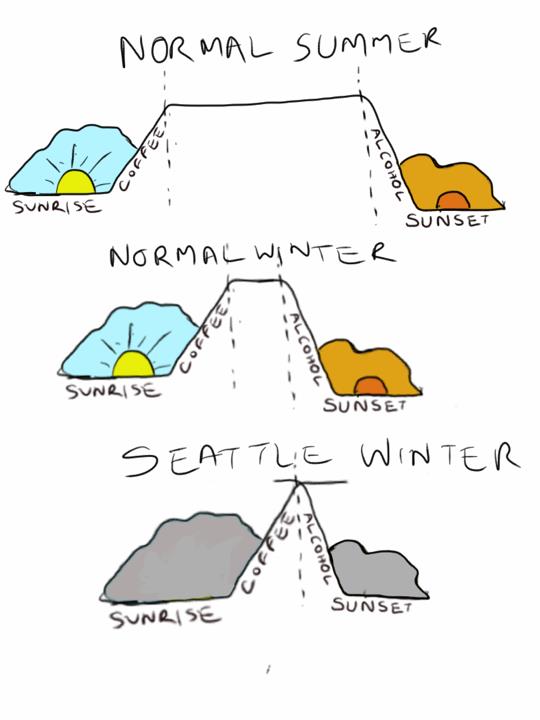
that marks its decline. A line from Alain de Botton’s The Pleasures and Sorrows of Work [10] has stayed with me since I first read it:
Office civilization could not be possible without the hard takeoffs and landings effected by coffee and alcohol.
A civilization enjoying a period of relative calm, of the sort the
Silents and Boomers enjoyed, can afford to to ritualize its drug use. I
grew up drinking perhaps one small cup of coffee in the morning and one
cup of tea in the afternoon. Now, like many Americans, I seem to down
coffee by the unceremonious, burnt gallon. That’s what it takes to buy
some pillows and avoid breaking bad.
We are about as far from the Japanese tea ceremonies and English
afternoon tea as civilization can get. In fact, my de Botton routine has
finally gotten to absurdity, now that I live in Seattle with its short
days. I made up a little cartoon recently to illustrate this:
 [11]
[11]
Let me hasten to reassure here: I exaggerate for comic effect. I am
not yet a raging coffee-alcoholic (at least 2 people messaged me with
concern when I posted the cartoon above on Facebook, and advised me to
take more Vitamin D supplements; rest assured, I do take my Vitamin D
quite religiously).
Jokes aside, the American Pacific Northwest does seem to be the
epicenter of the ongoing economic quake. It is at once home to the
prototypical enterprises of a globalized post-Internet world (Boeing,
Microsoft, Amazon and the Port of Seattle, which handles a large chunk
of American container traffic coming in from Asia) and the most
determined efforts to deny that a transformation is happening at all,
through an almost religious belief and engagement in small-and-local
thinking. The region is chock-full of backyard humane eggeries, Arduino
enthusiasm and coworking spaces.
The pharmacology of this regional transformation is a fascinating
phenomenon. The state of Washington is the coffee capital of America,
and recently legalized marijuana, but it endures some of the highest
alcohol taxes in the nation. I don’t know what that adds up to (I am
told the high hard alcohol taxes are primarily about supporting the
local wine and beer industries).
Last weekend, during a getaway to Portland in neighboring Oregon, I
stocked up on cheaper alcohol. I’ll save my take on Oregon and Portland
hipsterdom for another rainy day.
Beyond Anomie
Rather strangely for me, I am feeling unusually optimistic these days.
Perhaps it is sheer surprise at having survived [12] almost two years as a free agent without going destitute. Like Arthur Dent in the Hitchhiker’s Guide, I
may have learned to fly by accidentally missing the ground while
falling down. I have no clear ideas about how the emerging economy
works, but apparently I have a place within it for the time being.
But I don’t think that’s really it. I see a cautious optimism catching on more broadly. It isn’t just me.
Perhaps it was the opportunity for a cathartic collective projection
of anxieties that the Mayan apocalypse afforded us last year. Making
jokes about a dramatic end-of-history scenario (my favorite was a
repurposed Superstorm Sandy fake picture with Godzilla in it,
re-captioned for the Mayan end-times) might have helped us dress right
for a less dramatic end-of-chapter scenario. Or perhaps it was the
fiscal cliff farce.
Whatever the cause, I am getting the sense that the worst of the
psychological trauma of the transition may be behind us (the actual
economic damage is probably yet to peak).
At the very least, we seem to be past the denial and anger stages of
the Kubler-Ross process of mourning. We have accepted the impending
demise of a way of life. The mainstream appears to be somewhere between
negotiation and depression, and I think a few of us at least have moved
on to acceptance.
It’s a start. I am going to try and sober up a bit and see if I keel
over with future nausea or remain standing. If I do, I’ll try and figure
out what to do with the rest of my life. Look for purpose and stuff.
Purpose and Stuff
I’ll leave you with one final idea today, about the relationship
between purpose without institutions, under-utilized potential and
prescription drugs.
Like many who have a background in the decision sciences, I have a
strong belief in the power of regression focusing: the idea that working
backwards from a goal is more tractable than working forwards from a
prevailing situation. Many AI systems use regression focusing to
simplify automated planning.
For humans, narratives grand and small, encoded within viable
institutions and default scripts, are what supply purpose to human
striving. Even when prevailing big-P purposes — such as space
exploration in the last century — are hopelessly romantic, they serve to
drive the story. Unattainable P-urposes seem to be the stones in our
repeated attempts to brew stone soup [13] (“Ah, but a man’s reach should exceed his grasp, or what’s a heaven for?” Robert Browning [14],
who wrote that in 1855, lived through the industrial revolution, and
was among those who managed to navigate it with optimism rather than
despair; he was a trustafarian, but it would be unfair to hold that
against him).
When prevailing narratives prove inadequate for filling the vacuum of
purpose, anomie descends. And we head to the drugstore for something
stronger.
In times of peace, we are born to purpose, into middle-class scripts.
In times of chaotic change, finding purpose becomes the purpose. There
is a neat little idea (due to Teilhard de Chardin I think; I can’t
remember where I first encountered it or the exact quote) that “purpose
is not given us in our lives, it is the work of a lifetime to find
purpose.”
That is more true in some eras than in others. This is one such era.
We are living through a period where our mainstream grand narrative is
driven by an over-medicated, over-caffeinated and inebriated faith in
the cargo cult of failing middle class scripts.
But to abandon the cargo cult and look for purpose is a risky
undertaking. Anomie and uncomprehending what-hit-me destitution await
those who try and fail.
Staying with the cargo cult is almost as risky, and getting riskier
by the year. For many significant at-risk populations, the question is
not whether to jump, but when. Too early or too late, and you get
killed. Unsustainable arbitrariness is the fate of those who don’t
abandon ship in time (more on cargo cults another day; they are becoming
my latest obsession. My working hypothesis is that hipsterdom is one of
many middle-class cargo cults emerging today).
I don’t know what the big P-purpose of the post-industrial age
civilizational grand narrative is (it is definitely not space
exploration), but there is a certain peace to be found in accepting a
plurality of little-p purposes and smaller meanings while we figure it
out. I find it encouraging that many are finding meaningful commitments
in their individual lives, even as horizons shrink and triumphalist
globalism wanes, just as it did during the Gatsby era in the early part
of the twentieth century. This phenomenon can seem like fatalism (Bruce
Sterling’s “Dark Euphoria”), but there is a chance it is merely an
emerging healthy pragmatism.
When slowly falling expectation levels meet slowly increasing
commitment levels, angst slowly starts getting squeezed out of your
life. Life begins the day after you give up trying to figure it out. As
one of my clients likes to say, it’s a beautiful thing.
We might abandon the drugs and brew up a new pot of stone soup yet.

No comments:
Post a Comment